
Table of Contents
Physiotherapy for Older Adults: Improving Strength, Balance and Everyday Mobility
Staying active can become more challenging as we get older. Tasks that once felt effortless, such as getting up from a chair, climbing stairs, walking outdoors or carrying groceries, may gradually become more difficult.
This does not mean that reduced strength or mobility should simply be accepted as part of ageing.
Physiotherapy can help older adults work on physical abilities that are important for everyday life, including strength, balance, mobility and functional movement. The appropriate programme depends on the individual’s health, physical ability, previous injuries and goals.
The aim is not necessarily to exercise harder. It is to help you move more safely and confidently and maintain as much independence as possible.
Why can strength and mobility change with age?
Strength and physical capacity can change when activity levels decrease.
This may happen gradually through reduced exercise and everyday movement, or more quickly following an illness, injury, hospitalisation or surgery.
Reduced strength can make ordinary activities more demanding. For example, you may notice difficulty:
- Getting up from a chair
- Climbing stairs
- Walking longer distances
- Carrying household items
- Getting in and out of a car
- Maintaining balance
- Moving around unfamiliar environments
Once these activities become more difficult, it can be tempting to avoid them.
However, becoming less active can further reduce physical capacity. This can create a cycle in which everyday movement becomes increasingly difficult.
Physiotherapy can help address this through an appropriate and progressive rehabilitation programme.
How can physiotherapy help older adults?
Physiotherapy is not only for recovering from an injury.
For older adults, it can also focus on maintaining or improving physical function that supports everyday independence.
Depending on the assessment, rehabilitation may work on:
- Muscle strength
- Joint mobility
- Balance
- Coordination
- Walking ability
- Functional movement
- Physical endurance
- Confidence with movement
The specific exercises and activities should be adapted to the individual’s current ability.
Someone who is already physically active may require a very different programme from someone who has recently become less mobile.
Building strength for everyday activities
Strength is useful for much more than exercise.
Your leg and hip muscles, for example, contribute to movements such as standing up, walking and climbing stairs. Upper-body strength can also be relevant for carrying objects and performing everyday tasks.
A physiotherapist may therefore use exercises that relate to the activities you want to perform.
Depending on your ability, rehabilitation may include exercises such as controlled sit-to-stand movements, step exercises or other strengthening activities.
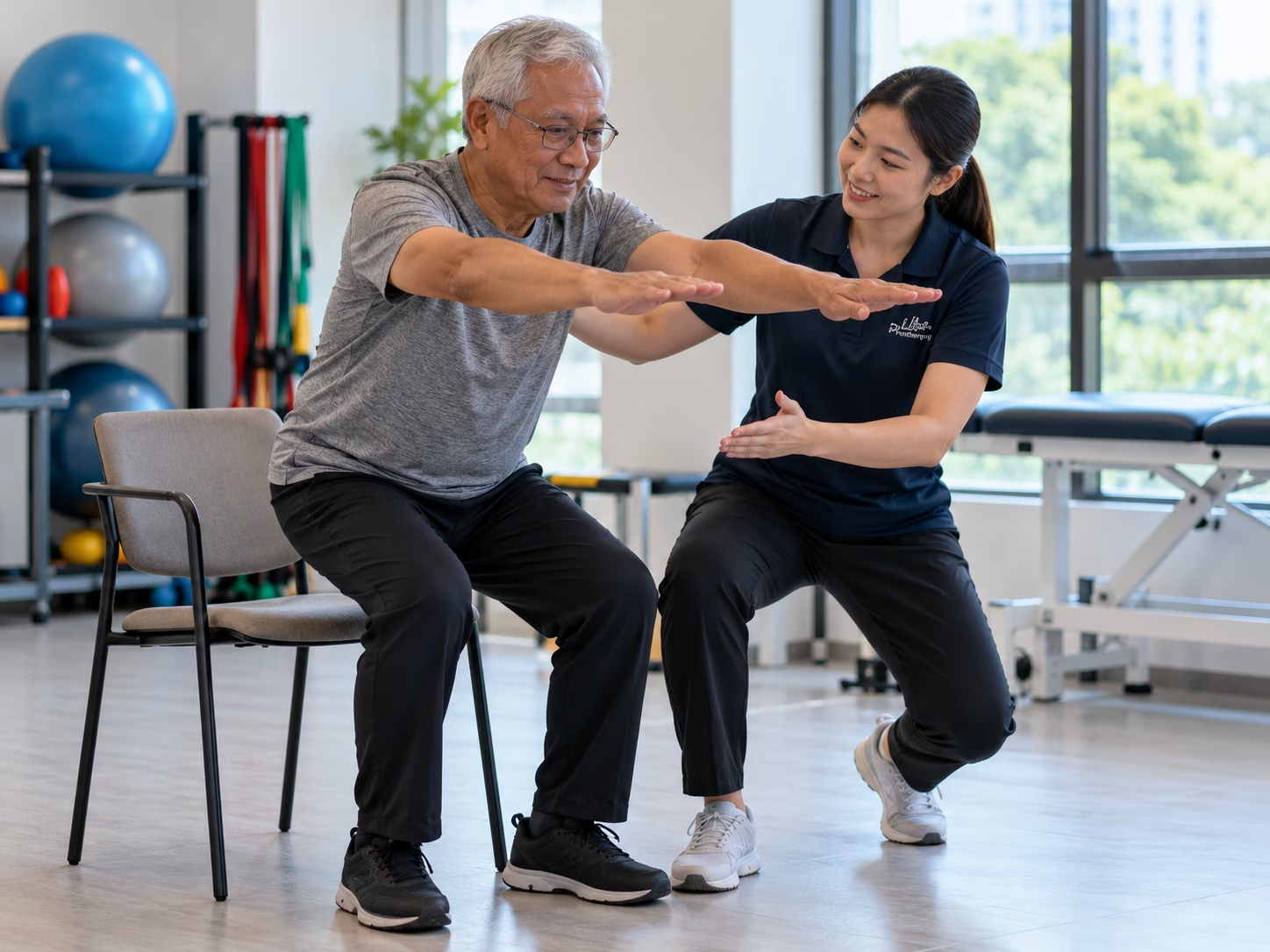
The programme can then be progressed as your strength and control improve.
The goal is not simply to increase muscle strength as an isolated measurement. It is to improve your ability to use that strength during everyday activities.
Balance becomes especially important
Balance affects many aspects of daily movement.
You may need good balance when:
- Walking on uneven surfaces
- Turning while walking
- Stepping over obstacles
- Getting out of a chair
- Using stairs
- Moving around crowded environments
Balance can be affected by many factors, including strength, mobility, coordination and previous falls or injuries.
A physiotherapist can assess relevant aspects of balance and develop exercises appropriate to your ability.
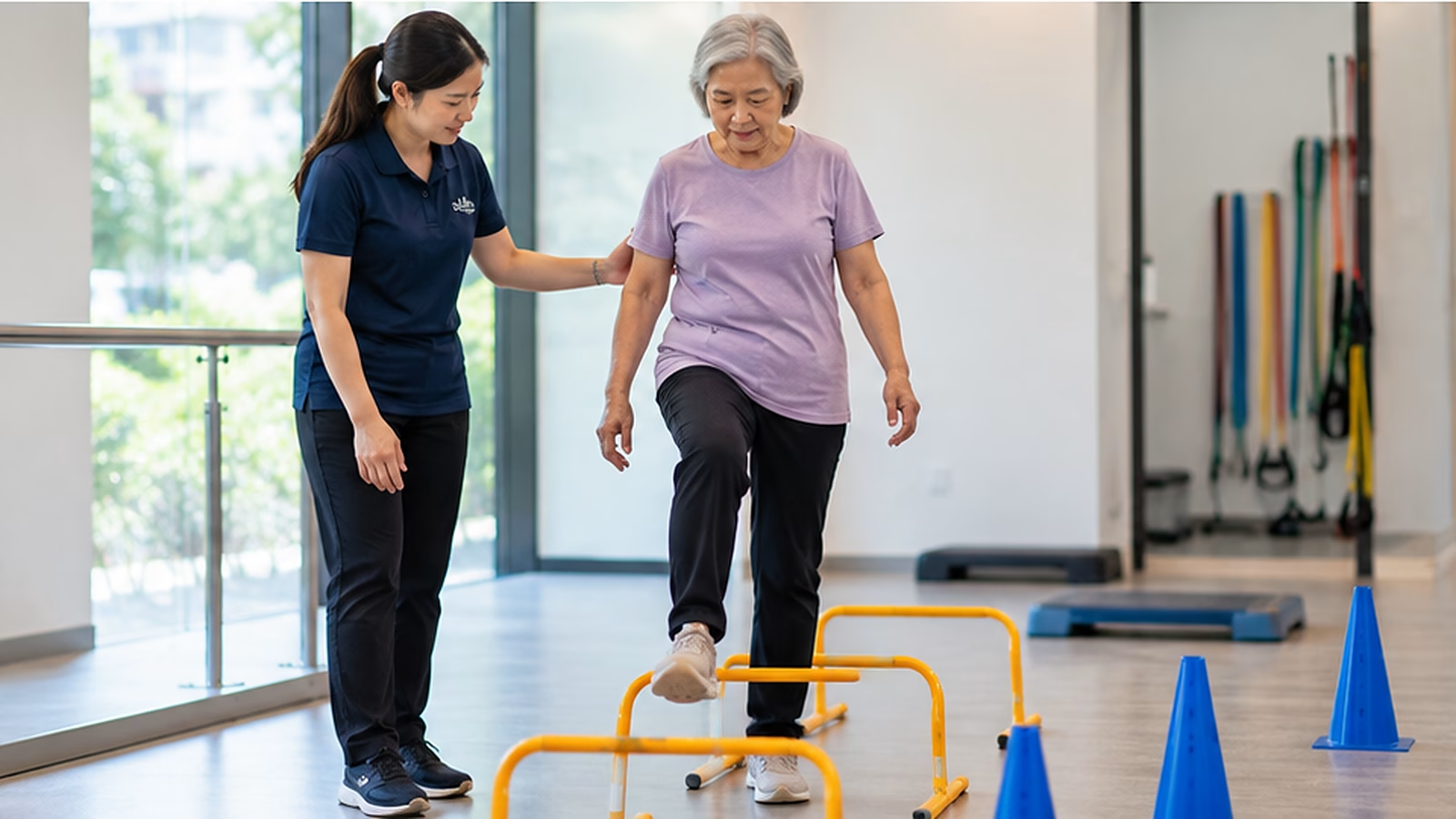
These exercises can be progressed gradually as your control and confidence improve.
Improving walking and everyday mobility
Walking is one of the most important forms of everyday mobility.
If pain, weakness, stiffness or reduced balance has changed the way you walk, physiotherapy may help address the physical factors contributing to the problem.
An assessment may consider how you move, how much you can currently walk and whether particular activities cause difficulty.
Rehabilitation can then focus on improving the physical abilities required for your normal walking and daily activities.
If you use a walking aid, your physiotherapist can also consider how it is being used and whether additional guidance is appropriate.
Physiotherapy can help after a period of inactivity
Older adults may become less active following an injury, surgery, illness or an extended period of rest.
Even when the original problem has improved, you may find that your strength and confidence have not fully returned.
For example, someone may be medically recovered after an operation but still struggle to climb stairs or walk longer distances.
Rehabilitation can provide a structured way to gradually rebuild physical capacity rather than attempting to return immediately to previous activity levels.
The starting point should reflect your current ability, not what you could do before the period of inactivity.
Exercise does not need to be complicated
An effective rehabilitation programme does not necessarily require complicated exercises or specialised equipment.
The most useful exercises are often those that are appropriate to your ability and relevant to your goals.
For one person, the focus may be improving the ability to stand from a chair.
For another, it may be walking for longer, improving stair confidence or returning to a regular exercise routine.
Lo Physiotherapy identifies exercise therapy as an important part of its treatment approach, with exercises tailored to individual conditions and needs.
The programme should be adjusted as your physical ability changes rather than remaining exactly the same throughout rehabilitation.
Confidence matters too
Physical ability and confidence do not always recover at the same pace.
After a fall or injury, you may become hesitant about walking outdoors, using stairs or performing movements that previously felt normal.
This can lead to avoiding activities unnecessarily.
A gradual rehabilitation programme can help you practise relevant movements in a controlled environment before progressing towards more demanding activities.
The goal is not to ignore fear or force yourself into movements you are not ready for. It is to progressively build physical ability and confidence at an appropriate pace.
What happens during an assessment?
A physiotherapy assessment for an older adult should be based on the individual’s situation rather than age alone.
Your physiotherapist may ask about:
- Your current mobility
- Any pain or physical limitations
- Previous injuries or surgery
- Your usual daily activities
- Exercise and activity levels
- Any difficulties with walking or stairs
- Your goals for rehabilitation
Depending on your needs, the physical assessment may look at strength, movement, balance, walking and functional activities.
You can also explain which activities are most important to you.
For example, your goal may simply be to walk around your neighbourhood more comfortably or get up from a chair without assistance.
These practical goals can help shape your rehabilitation programme.
When should an older adult consider physiotherapy?
You do not have to wait until mobility has become severely restricted.
Consider a physiotherapy assessment if you are experiencing:
- Increasing difficulty with everyday movement
- Reduced strength
- Balance problems
- Difficulty climbing stairs
- Changes in walking ability
- Recovery difficulties after surgery or injury
- Fear or reduced confidence when moving
- Pain that limits normal activities
Physiotherapy may also be useful if you want to remain active and maintain your ability to perform everyday activities.
However, sudden or unexplained changes in mobility, significant weakness, repeated falls or other concerning symptoms may require medical assessment to determine the underlying cause.
Frequently Asked Questions
1. Is physiotherapy suitable for older adults who are not very active?
Yes. Physiotherapy can be adapted to different levels of physical ability. An older adult who is currently inactive does not need to be able to exercise at a high intensity before starting rehabilitation. The programme can begin with manageable movements and gradually progress as strength, mobility and confidence improve.
2. Can physiotherapy help an older adult who is afraid of falling?
It may help address physical factors that contribute to reduced confidence, such as weakness, balance limitations or difficulty with certain movements. A physiotherapist can assess relevant aspects of mobility and introduce appropriate exercises progressively. However, repeated or unexplained falls should also be discussed with a medical professional.
3. How often should older adults do physiotherapy exercises?
There is no single schedule suitable for everyone. The appropriate frequency depends on the person’s condition, exercise programme, physical ability and rehabilitation goals. Your physiotherapist can advise how often to perform specific exercises and how to progress them without unnecessarily overloading your body.
4. Should I wait until I have pain before seeing a physiotherapist?
Not necessarily. Physiotherapy can also address reduced strength, balance, mobility and physical function. If everyday activities are becoming more difficult or you are becoming less active because of physical limitations, an assessment may help identify appropriate ways to maintain or improve your mobility before the problem becomes more restrictive.
Physiotherapy is about maintaining function, not simply treating pain
For older adults, the most meaningful measure of rehabilitation may not be whether a particular muscle has become stronger.
It may be whether you can do more of the things that matter to you.
That could mean:
- Getting out of a chair independently
- Walking to the shops
- Using stairs more confidently
- Moving around your home safely
- Returning to a favourite activity
- Maintaining an active lifestyle
Physiotherapy can help identify physical limitations and develop a programme designed around these practical goals.
At Lo Physiotherapy, physiotherapy and rehabilitation services are provided for musculoskeletal conditions and functional recovery, with treatment and exercise programmes tailored to individual needs.