
Table of Contents
Knee Pain When Climbing Stairs: Common Causes and When Physiotherapy May Help
Climbing stairs can reveal knee problems that are not always noticeable during normal walking.
You may feel pain when going upstairs, coming downstairs, bending your knee or putting more weight through one leg. For some people, the discomfort may be occasional. For others, it can gradually make everyday activities such as using stairs, exercising or getting up from a chair more difficult.
Knee pain when climbing stairs does not point to one specific condition. It can have several possible causes, which is why an assessment is more useful than trying to identify the problem from the symptom alone.
Physiotherapy may be appropriate for some causes of knee pain and can focus on improving relevant movement, strength and physical function.
Why can climbing stairs cause knee pain?
Climbing stairs places greater physical demands on the knee than simply standing or walking on level ground.
As you step up, your knee needs to bend while your leg muscles work to support and move your body. Going downstairs also requires controlled movement as you lower your body onto the next step.
If your knee is painful, stiff or not tolerating the load well, these movements may make the symptoms more noticeable.
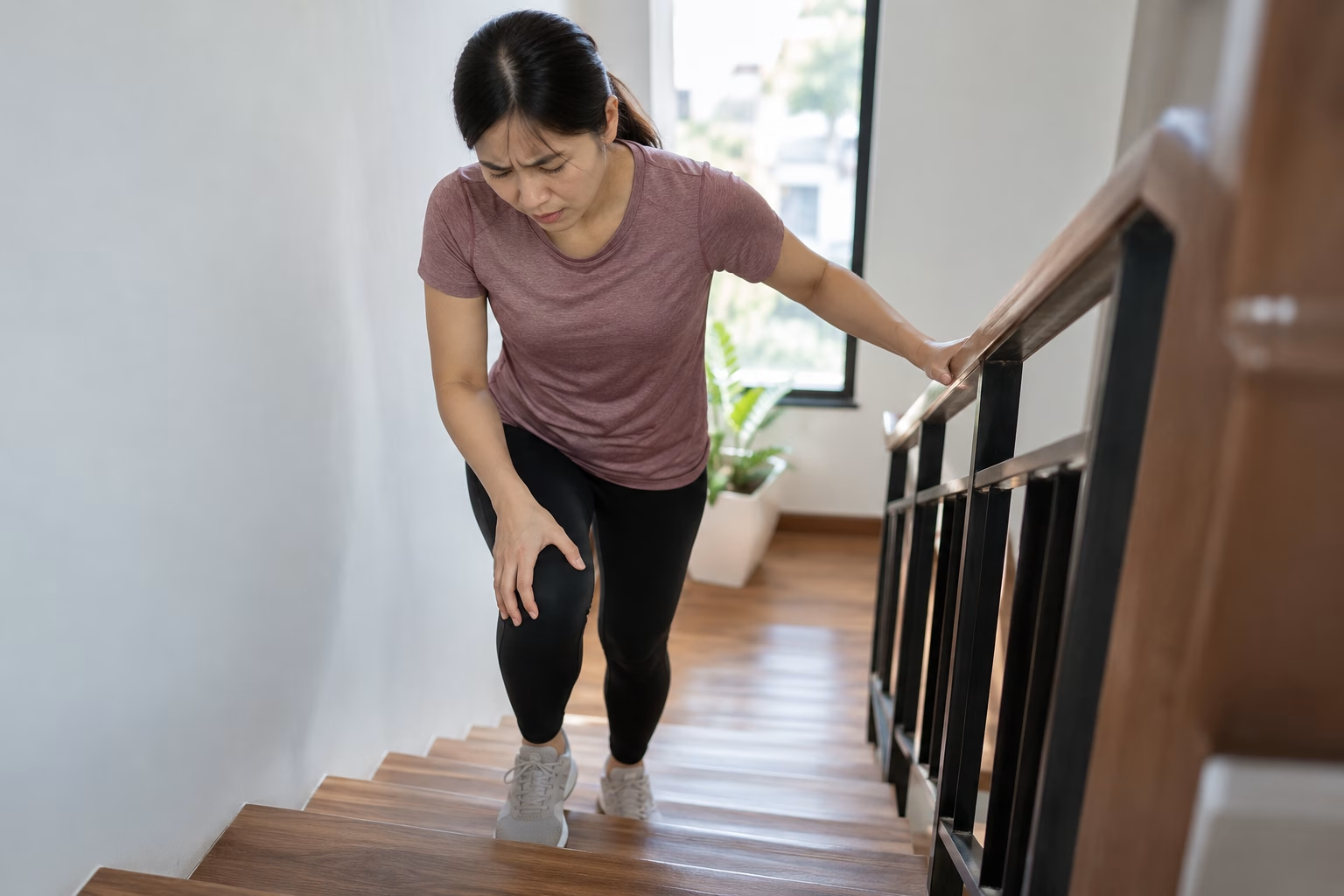
The location and nature of the pain can provide useful information, but they are not enough to determine the exact cause.
Possible contributors include problems involving the tissues around the knee, changes in joint function, previous injuries, muscle weakness, changes in activity or other musculoskeletal conditions.
Pain at the front of the knee
Pain around the front of the knee is commonly associated with patellofemoral pain, although several conditions can cause pain in this area.
You may notice discomfort when:
- Climbing or descending stairs
- Squatting
- Sitting down or standing up
- Running
- Jumping
- Sitting for a prolonged period with your knees bent
The pain may become more noticeable when the knee is repeatedly loaded during these activities.
However, front-of-knee pain does not automatically mean you have patellofemoral pain. A proper assessment is needed to understand your symptoms and determine what may be contributing to them.
Previous knee injuries can affect how stairs feel
If you have previously injured your knee, you may notice discomfort when returning to activities that require more strength or control.
For example, after a period of reduced activity following an injury, you may find that normal walking feels comfortable but stairs remain difficult.
Previous injuries can also affect confidence in using the affected leg.
This does not necessarily mean the original injury has returned. Your current symptoms may reflect reduced strength, mobility or tolerance to activity, among other possibilities.
A physiotherapy assessment can help determine what has changed and whether rehabilitation may be appropriate.
Muscle weakness may contribute to difficulty on stairs
Your knee does not work in isolation.
The muscles around your hip and knee contribute to controlling your leg as you move. If these muscles have become weaker after an injury or period of inactivity, certain activities may become more difficult.
You may notice that:
- One leg feels weaker than the other
- You rely more heavily on the handrail
- You avoid putting full weight through one leg
- Your knee feels less stable during certain movements
- Stairs are more difficult than level walking
Weakness is only one possible contributor, however. It should not be assumed to be the cause of knee pain without an appropriate assessment.
Why can going downstairs feel different?
Some people find descending stairs more uncomfortable than climbing up.
This is because going downstairs requires your muscles to control the movement as your body lowers towards the next step.
The symptoms you experience going up and down stairs may therefore provide useful information during an assessment.
Tell your physiotherapist whether the pain occurs:
- Only when going upstairs
- Only when going downstairs
- During both
- At the beginning or end of the staircase
- When carrying something
- After exercise or prolonged activity
These details can help establish a clearer picture of the problem.
What other symptoms should you pay attention to?
Knee pain is not the only information that matters.
It is useful to notice whether you also have:
- Swelling
- Stiffness
- Reduced knee movement
- Clicking or other sensations
- A feeling of instability
- Difficulty putting weight through the leg
- Pain during exercise
- Symptoms that continue after activity
Also consider whether the problem started after a specific injury or developed gradually.
These details can help your healthcare professional determine what type of assessment may be appropriate.
When may physiotherapy help?
Physiotherapy may be appropriate when knee pain is affecting your movement or ability to perform normal activities.
A physiotherapist can assess relevant aspects of your condition, which may include knee movement, strength, functional movement and how your symptoms respond to different activities.
The rehabilitation programme depends on the findings.
It may involve:
- Exercise therapy
- Strengthening
- Mobility exercises
- Movement retraining
- Activity modification
- Education about managing your symptoms
- Gradual progression back to exercise or other activities
Lo Physiotherapy provides physiotherapy and rehabilitation for knee pain and other musculoskeletal conditions, with exercise therapy forming part of its treatment approach.
The appropriate treatment should be based on your individual assessment rather than simply applying the same treatment to everyone with knee pain.
Why strengthening may be part of rehabilitation
If your assessment identifies relevant weakness or reduced physical capacity, strengthening exercises may form part of your rehabilitation.
The objective is not simply to make your leg stronger in general.
The exercises should be appropriate to your current ability and progressively developed towards the activities you want to perform.
For someone whose main problem is climbing stairs, rehabilitation may eventually involve movements that require controlled loading of the leg.
For someone who wants to return to running or sport, the demands will be considerably higher and may require further progression.
Should you stop using stairs if your knee hurts?
Not necessarily.
If stairs are part of your everyday routine, completely avoiding them may not always be practical or necessary.
However, repeatedly forcing through significant pain is also not a sensible approach.
You may need to temporarily modify your activity depending on the severity of your symptoms. Using a handrail, reducing unnecessary trips up and down stairs or adjusting other activities may help reduce demands while the problem is being assessed.
If the pain continues or repeatedly returns, consider getting it assessed rather than relying on activity avoidance indefinitely.
When should you get your knee assessed?
Consider a physiotherapy assessment if your knee pain:
- Continues or repeatedly returns
- Makes stairs increasingly difficult
- Limits exercise or sport
- Affects walking or other daily activities
- Causes you to favour one leg
- Has not improved as expected after an injury
- Is accompanied by weakness or reduced movement
You do not need to wait until the pain becomes severe before seeking an assessment.
However, some knee problems require medical assessment rather than routine physiotherapy.
Seek prompt medical attention if you have experienced significant trauma, cannot put weight through the leg, have substantial swelling or deformity, or have severe or rapidly worsening symptoms.
What happens during a physiotherapy assessment?
Your physiotherapist will first ask about your symptoms and how they affect your activities.
Be prepared to explain:
- When the knee pain started
- Whether there was an injury
- Where you feel the pain
- Whether stairs or other activities trigger it
- Whether going up or down is worse
- Whether you have swelling or stiffness
- What activities you currently avoid
- What you want to return to doing
A physical assessment may then look at relevant movement, strength, mobility and functional activities.
Depending on your symptoms, this may include observing movements that reproduce your usual activities.
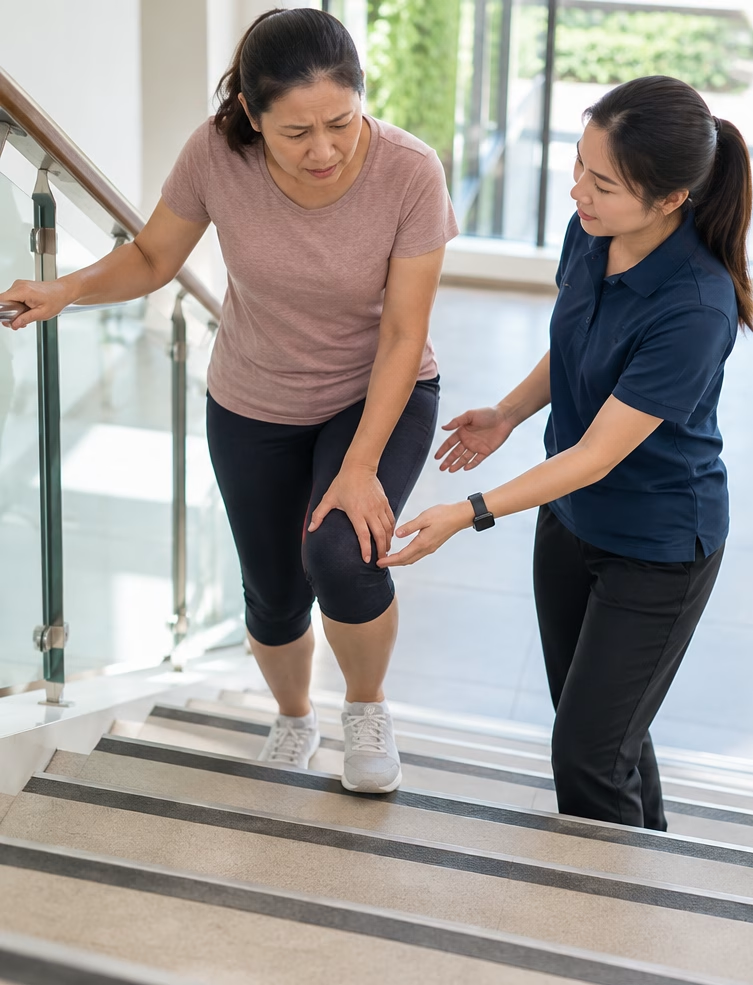
The findings can help determine whether physiotherapy is appropriate and what type of rehabilitation may be suitable.
Do not assume every knee pain needs the same treatment
“Knee pain” describes a symptom, not a single condition.
Pain when climbing stairs can occur for different reasons, and the appropriate management depends on the individual.
That is why treatment should follow assessment rather than starting with a particular treatment simply because it is commonly used for knee pain.
For some people, exercise and rehabilitation may be central to recovery. Others may require different management or further medical investigation.
Frequently Asked Questions
1. Why does my knee hurt going downstairs but not when walking?
Going downstairs requires the muscles around your knee and hip to control your body as you lower onto each step. This can place different demands on the knee compared with level walking. The pattern can provide useful information, but it does not identify the cause by itself and should be assessed alongside your other symptoms.
2. Should I keep climbing stairs if my knee hurts?
It depends on the severity and cause of your symptoms. You do not necessarily need to avoid stairs completely, but repeatedly forcing through significant pain is not advisable. Temporarily reducing unnecessary stair use or modifying activity may help while you arrange an assessment if the problem persists.
3. Can physiotherapy help if my knee pain only happens on stairs?
It may, depending on what is causing the pain. A physiotherapist can assess your knee movement, strength and relevant functional movements to identify factors that may be contributing to your symptoms. Rehabilitation may include strengthening, mobility work, activity modification or gradual progression towards your normal activities.
4. When should knee pain on stairs be checked by a doctor instead of a physiotherapist?
Seek medical assessment when knee pain follows significant trauma, you cannot put weight through the leg, there is substantial swelling or deformity, or the pain is severe or rapidly worsening. If symptoms are persistent but mainly affect movement and function, physiotherapy assessment may be appropriate depending on the circumstances.
Get the knee assessed if stairs are becoming a problem
Occasional knee discomfort does not necessarily mean that you have a serious knee condition.
However, if climbing stairs consistently causes pain, particularly when the problem is affecting your walking, exercise or daily routine, it is worth understanding why.
A physiotherapy assessment can look beyond the painful movement and consider your symptoms, strength, mobility, function and activity demands.
At Lo Physiotherapy, knee pain is among the musculoskeletal conditions managed through physiotherapy and rehabilitation, with knee treatment selected according to the individual’s condition and needs.